Vatican Council II: Constitutions, Decrees, Declarations by Austin Flannery
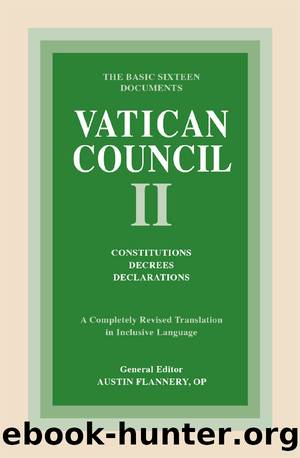
Author:Austin Flannery
Language: eng
Format: azw3
Publisher: Liturgical Press
Published: 1996-04-30T16:00:00+00:00
II. Diocesan Boundaries
22. For a diocese to fulfill its purpose it is necessary that the nature of the church be clearly manifested in the people of God belonging to the diocese. Bishops must be able to carry out their pastoral function effectively among their people, and finally the spiritual welfare of the people of God must be catered for as perfectly as possible. This requires not only a proper determination of the territorial limits of the diocese but also a reasonable distribution of clergy and resources in accordance with the needs of the apostolate. All these things contribute to the good, not only of the clergy and the faithful who are directly involved, but also of the entire church.
Therefore as regards diocesan boundaries the sacred synod decrees that, insofar as the good of souls requires it, a prudent revision of diocesan boundaries be undertaken as soon as possible. This can be done by dividing, distributing or uniting dioceses, changing their boundaries, or appointing a more suitable place for the episcopal see, or finally, and especially in those dioceses which comprise larger cities, by establishing a new internal organization.
23. In revising diocesan boundaries a first care should be the preservation of the organic unity of each diocese, as in a healthy living body. This applies to persons, offices and institutions. Due weight being given in individual cases to the particular circumstances, the following general criteria should be borne in mind:
(1) In determining diocesan boundaries the variety of the composition of the People of God should be taken into consideration as far as possible, since this may materially contribute to more effective pastoral care.
At the same time an effort should be made to ensure as far as possible that the demographic groupings remain united with the civil offices and institutions which constitute their organic structure. For this reason the territory of each diocese should form a continuous whole.
The limits of civil boundaries should also be taken into account where they occur, as well as the special characteristics — psychological, economic, geographical or historical — of people and regions.
(2) The size of the diocesan territory and the number of its inhabitants should as a general rule be such that on the one hand the bishop himself, assisted perhaps by others, is able to duly exercise his pontifical functions and carry out his pastoral visitations in it. He should also be in a position to control and coordinate effectively all the apostolic activities in his diocese, and especially to know his priests and all the religious and lay people who are involved in diocesan activities. On the other hand, a diocese should provide sufficient and suitable scope for the bishop and his priests to employ usefully all their energies in the ministry, taking into account the needs of the universal church.
(3) Finally, for the more effective exercise of the ministry of salvation the norm should be that each diocese would have enough priests capable of properly caring for the people of God. Offices, institutions
Download
This site does not store any files on its server. We only index and link to content provided by other sites. Please contact the content providers to delete copyright contents if any and email us, we'll remove relevant links or contents immediately.
The Lost Art of Listening by Michael P. Nichols(7507)
Why I Am Not A Calvinist by Dr. Peter S. Ruckman(4154)
The Rosicrucians by Christopher McIntosh(3521)
Wicca: a guide for the solitary practitioner by Scott Cunningham(3180)
Signature in the Cell: DNA and the Evidence for Intelligent Design by Stephen C. Meyer(3140)
Real Sex by Lauren F. Winner(3025)
The Holy Spirit by Billy Graham(2954)
To Light a Sacred Flame by Silver RavenWolf(2826)
The End of Faith by Sam Harris(2744)
The Gnostic Gospels by Pagels Elaine(2536)
Waking Up by Sam Harris(2461)
Nine Parts of Desire by Geraldine Brooks(2373)
Jesus by Paul Johnson(2364)
Devil, The by Almond Philip C(2337)
The God delusion by Richard Dawkins(2313)
Heavens on Earth by Michael Shermer(2285)
Kundalini by Gopi Krishna(2187)
Chosen by God by R. C. Sproul(2165)
The Nature of Consciousness by Rupert Spira(2109)
